
Top Service Management Solutions in 2026
Today's rapid digital business environment is causing many companies to require better service management tools for more efficient operation, to increase effectiveness, and to increase the quality of both customer and employee experience.
Service management tools enable improved performance in areas such as IT (information technology), human resources, facility management, and other enterprise-wide functions when used effectively.
Why Service Management Tools Matter
As businesses continue to expand, the complexity of delivering services across multiple departments becomes an increasing problem. A modern service management solution addresses these challenges by providing:
- An integrated platform for IT and enterprise-wide services.
- Automated processes for repetitive tasks.
- Actionable insights from analytics.
Companies that use manual processes or have separate systems and/or disconnected workflow processes may find their response time slowing and their employees frustrated, while also negatively affecting customer satisfaction.
Therefore, the appropriate tool will eliminate operational obstacles, enable better teamwork among departments, and provide excellent and timely service delivery.
1. Xurrent: AI-Powered Unified Service Management
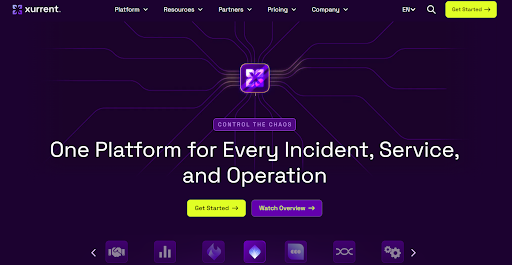
Xurrent is an advanced, cloud-based service management system that unifies service management across IT and enterprise groups. Xurrent provides both ITSM and ESM in one platform, thus allowing companies to reduce their reliance on individual group-specific systems and provide seamless service delivery.
Key Features
- Unified ITSM and ESM: ITSM and ESM provide unified platforms that manage all IT, HR, finance, facilities, and customer support services in one place and eliminate the need for multiple isolated systems.
- Automated by AI: AI automatically identifies ticket priority, categorizes and directs tickets, and provides the user with AI-based recommended knowledge articles and chat assistance to help them resolve their requests more quickly.
- Quick and Easy to Deploy and Configure using Low-Code: Enables fast deployment of low-code workflows for rapid go-live and ongoing configuration changes without needing extensive IT intervention.
- Practices Aligned to ITIL: The product supports incident, change, problem and request management practices and is flexible enough to accommodate organization-specific process needs.
- Service Integration & Collaboration (SIAM): The solution enables organizations to effectively coordinate between internal teams and external service provider teams to facilitate smoother cross-functional collaboration.
- Real-Time Dashboards and Reports: Provides real-time analytics and insights into service delivery effectiveness, identifies bottleneck areas, and facilitates data-driven decision making.
- Improved User and Employee Experience: Empowers employees and customers to find solutions to problems on their own via a self-service portal, AI-based chat assistant, and knowledge base.
- Flexible and Scalable: Designed to meet the needs of both medium-sized companies and large enterprise customers, designed to grow with your company without sacrificing performance.
Xurrent is best for large enterprises with a need for an all-in-one platform with AI to improve service delivery, accelerate their digital transformation, and provide a high level of visibility and analytics to support decision-making across all service operations.
2. ServiceNow
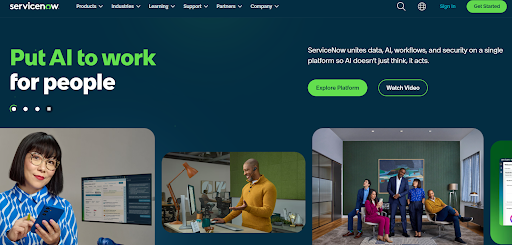
ServiceNow has become well known for its ability to handle large enterprise service management as well as IT service management requirements due to its scalability, integration capabilities, and advanced workflow automation.
Key Features
- ITSM & ESM: ServiceNow supports IT, HR, customer service, and security operations from a single platform.
- Automation & AI: Approvals, ticket routing, and other manual or repetitive tasks can be automated using ServiceNow to help increase productivity.
- Integration Ecosystem: Integration into most enterprise systems are possible through ServiceNow's integration ecosystem to allow for seamless operations.
- Customizable Dashboards: Analytics and reporting are available through customizable dashboards to track service delivery and performance metrics.
It will suit enterprises seeking a highly configurable, scalable service management solution able to handle complex workflows.
3. Freshservice
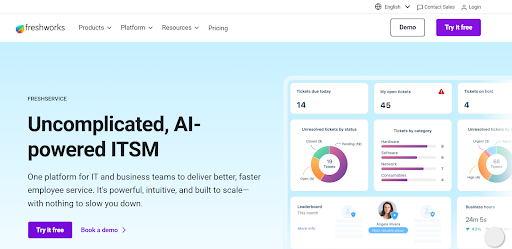
Freshservice provides a cloud-based Service Management Solution designed to be easy-to-use while providing an abundance of features. The ease of use and automated features are perfect for the rapidly growing IT team.
Key Features
- Ease of Use: Easy to learn and onboard.
- Automated and AI Assistance: Automates repetitive requests such as ticket routing and incident resolution.
- Modules Ready for ITIL: Includes modules for Incident, Problem, Change, and Asset Management.
- Employee Self-Service and Knowledge Base: Provides employees with the tools to solve their own problems in-house, therefore lowering the amount of time spent supporting them.
This solution is good for smaller to medium sized business or IT teams searching for a streamlined, straightforward solution
4. TeamDynamix
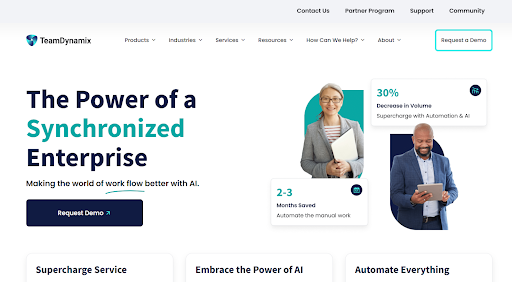
TeamDynamix is a no-code platform combining IT service management with PPM. Users can build their own workflows through a drag-and-drop interface.
Key Features
- Drag-and-Drop No-Code Workflow Interface: Allows users to create customized processes without IT assistance.
- Integration of Service Management and Project/Resource Management: Combines IT service management with project and resource management.
- Automated Guidance and Service Request Handling Through AI-Powered Assistance: Automatically guides users on how to complete tasks and automatically handles incoming service requests.
- Seamless Cross-Department Communication: Seamlessly connects all departments for collaboration.
Recommended for organizations seeking flexible options, an easy-to-use system, and a solution that combines service management and project management.
Choosing the Right Service Management Solution
When reviewing platforms to evaluate, take into consideration:
- Scope and scale: Do you have an IT-specific help desk or do you require a platform for your entire organization (HR, Facilities, Customer Service)?
- Implementation speed: Using low-code or no-code products such as Xurrent and Team Dynamix will typically allow for a much quicker implementation.
- Automation/AI: The use of artificial intelligence in automating tasks and the subsequent reduction of manual efforts will allow for faster service delivery.
- Integration Capabilities: Make sure that the platform can integrate quickly and easily with all of your existing systems.
Conclusion
Service management in 2026 will be focused on creating an environment of efficiency, transparency, and collaboration for all parts of the organization through the use of modern service management solutions. Modern solutions combine automation, AI, and unified workflows to reduce friction and improve service delivery at scale.
An organization's choice of approach allows it to operate with greater efficiency, to respond faster to changes, and ultimately to transform its service management practices into a sustainable long-term business advantage.
Make service management easier and more effective; use modern tools to work smarter and collaborate better.